
Does Moonlight Do Anything to Crystals?
Moonlight is weak reflected sunlight. Outdoor exposure can add dew, cooling and dirt—not a verified crystal-specific charge.
In this field note
“Does moonlight do anything?” contains several different questions. Light can reach a mineral. Gravity can act on it. A cold surface can collect moisture. A person can also attach meaning to placing an object under a full moon. Those statements do not establish the same kind of effect, so they need to be tested separately.
This article keeps four categories apart: illumination, gravity, outdoor exposure and ritual meaning. It does not attempt to catalogue sunlight-sensitive stones, diagnose human effects or decide what a private practice should mean.
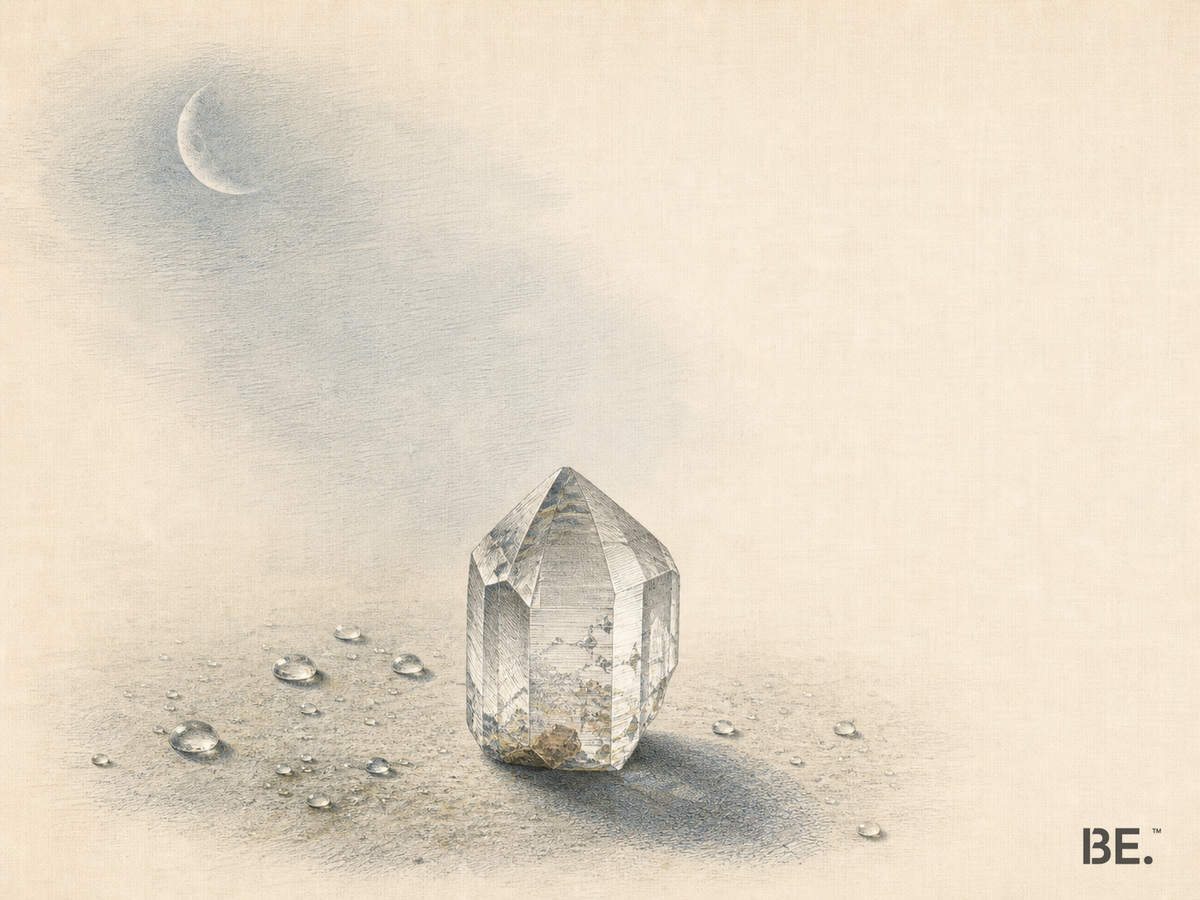
What is moonlight, physically?
Reflected sunlight, not light generated by the Moon
The visible Moon is lit by the Sun. NASA describes moonlight as sunlight reflected from the lunar surface, which returns only a fraction of the light that reaches it. The spectrum and brightness observed on Earth vary with lunar phase, viewing geometry and atmospheric conditions. Moonlight is therefore a real, measurable optical input, but it is not a separate category of radiation unique to crystals.
Why intensity and spectrum matter
“Light” is not a single dose. Illuminance in lux describes visible light as weighted for human vision; spectral irradiance describes power across wavelengths. The two measurements are not interchangeable. A 2017 review in Astronomy & Geophysics places typical full-moon illuminance at roughly 0.05–0.1 lux, illustrating how dim it is compared with daylight. That comparison does not create a universal fading threshold for every gemstone, dye, coating, cord or setting.
All light carries energy, and materials can absorb, transmit or reflect parts of it. That ordinary statement is different from claiming that a bracelet stores a special lunar charge. A material claim needs a defined property, a repeatable measurement, a control and a result that exceeds ordinary environmental variation.
Does moonlight charge or cleanse crystals?
No controlled evidence shows a crystal-specific charging or cleansing mechanism under moonlight. “Charged” is often left undefined: it might mean electrical charge, stored optical energy, a change in temperature, a spiritual state or simply a refreshed personal association. Those meanings cannot be substituted for one another.
A useful test is to ask what should change after exposure. Mass, surface chemistry, colour, electrical potential and crystal structure are measurable properties. A felt sense of renewal is a personal report. Both can be described honestly, but a personal report does not demonstrate a change in the mineral lattice.
What about the Moon’s gravity?
Gravity is real and universal
The Moon contributes to tides through differential gravity across the scale of Earth. That is a documented physical effect. The same gravitational field also acts on a bracelet, its wearer, the table beneath it and the surrounding building. Nothing in the tide mechanism shows that quartz, feldspar or another jewellery material is selectively altered.
Why tides do not prove a special gemstone effect
Tides concern enormous bodies of water and the difference in gravitational pull across planetary distances. They are not evidence that a small mineral object is charged, cleansed or reprogrammed. Moving from “the Moon affects tides” to “the Moon changes this crystal in a special way” requires a separate, crystal-specific test. We did not find that test in the reviewed evidence.
What can actually change during a night outdoors?
Several ordinary candidates remain live. A surface that cools below the dew point can collect condensation. Jewellery can also encounter soil, airborne residue, rain, animals, hard surfaces or an accidental knock. Temperature changes may matter differently to a stone, a coating, a metal setting and a cord, so “safe for crystals” is too broad a promise.
Water droplets or a cold feel the next morning show that the object experienced an environment. They do not identify moonlight as the cause, and they do not show that the mineral stored an invisible charge. For routine care, a dry indoor place is the lower-risk choice. Questions about a specific stone’s light sensitivity belong in our sunlight guide, while cleaning and storage belong in the jewellery-care guide.
Can a moon ritual still have personal meaning?
Yes. A repeated act can mark time, focus attention, connect a person with a cultural practice or make an object feel newly considered. None of that requires a claim that the mineral’s internal structure changed.
Respecting ritual meaning and asking for physical evidence are compatible positions. The first concerns interpretation and experience; the second concerns measurable material change. BE. describes minerals through geology, optics, construction and wear. It does not ask a personal practice to serve as laboratory evidence, and it does not tell a wearer what that practice must mean.
Moonlight claims and their evidence boundaries
| Claim | Measurable input | What the evidence supports | Boundary |
|---|---|---|---|
| Moonlight reaches a crystal | Reflected solar radiation; phase- and geometry-dependent spectral irradiance | The object receives dim, ordinary light that can be measured and seen. | This does not demonstrate a special stored “charge”. |
| A full moon is brighter than many other lunar phases | Visible illuminance and spectral irradiance | Typical full-moon illumination is still very weak compared with daylight. | Lux cannot by itself predict fading, UV dose or a gem-specific response. |
| The Moon’s gravity is real | Universal gravity and differential tidal force | The Moon contributes to Earth’s tides. | Tides do not prove selective alteration of a bracelet or mineral lattice. |
| A stone is wet or cold in the morning | Surface temperature, dew point, humidity and exposure | Condensation can form when a surface cools below the dew point. | Moisture or cold is not evidence of lunar charging. |
| A ritual feels meaningful | Personal report and cultural context | The practice can hold personal or cultural meaning. | Meaning does not establish a measured change in material properties. |
Frequently asked questions
Q1.Does moonlight charge crystals?
Moonlight delivers a small amount of ordinary reflected sunlight, but we found no controlled evidence that it creates a special, stored charge in a gemstone. A spiritual or personal use of the word “charge” is a different category from a measured material change.
Q2.Is a full moon physically different from other phases?
A full moon generally produces more visible illumination at Earth than a crescent phase because of the Sun–Earth–Moon geometry. The reviewed evidence does not show that this brighter phase produces a special crystal-specific effect.
Q3.Can moonlight fade amethyst?
Moonlight is far dimmer than daylight, but a universal no-risk promise would require material-, spectrum-, dose- and time-specific data. Treat sunlight sensitivity as a separate care question and avoid using “moonlight” as blanket permission for every stone, coating or cord.
Q4.Is it safe to leave crystal jewellery outside overnight?
Not as a universal rule. Dew, rain, temperature change, dirt, impact and loss can affect the stone, metal or stringing in different ways. A dry indoor surface is the lower-risk option when the construction is unknown.
Q5.Does lunar gravity affect crystals?
The Moon’s gravity acts on crystals as it acts on other matter. The tidal effect observed at Earth scale does not demonstrate a selective change in a small gemstone or bracelet.
Q6.Can a moon ritual still be meaningful without changing the stone?
Yes. A ritual can organise attention, mark time or carry personal and cultural meaning without being evidence that a mineral’s physical properties changed.
References
Field Notes.
One stone at a time: its geology, and how to read quality. The Stone Buying Checklist comes with your first email.
By subscribing you agree to receive emails from BE. Unsubscribe anytime.
Sent. Check your inbox.