
How to Spot High-Quality Moonstone
Compare moonstone by moving sheen, viewing angle, bodycolour, cut, polish and bead condition—without treating appearance as identification.
In this field note
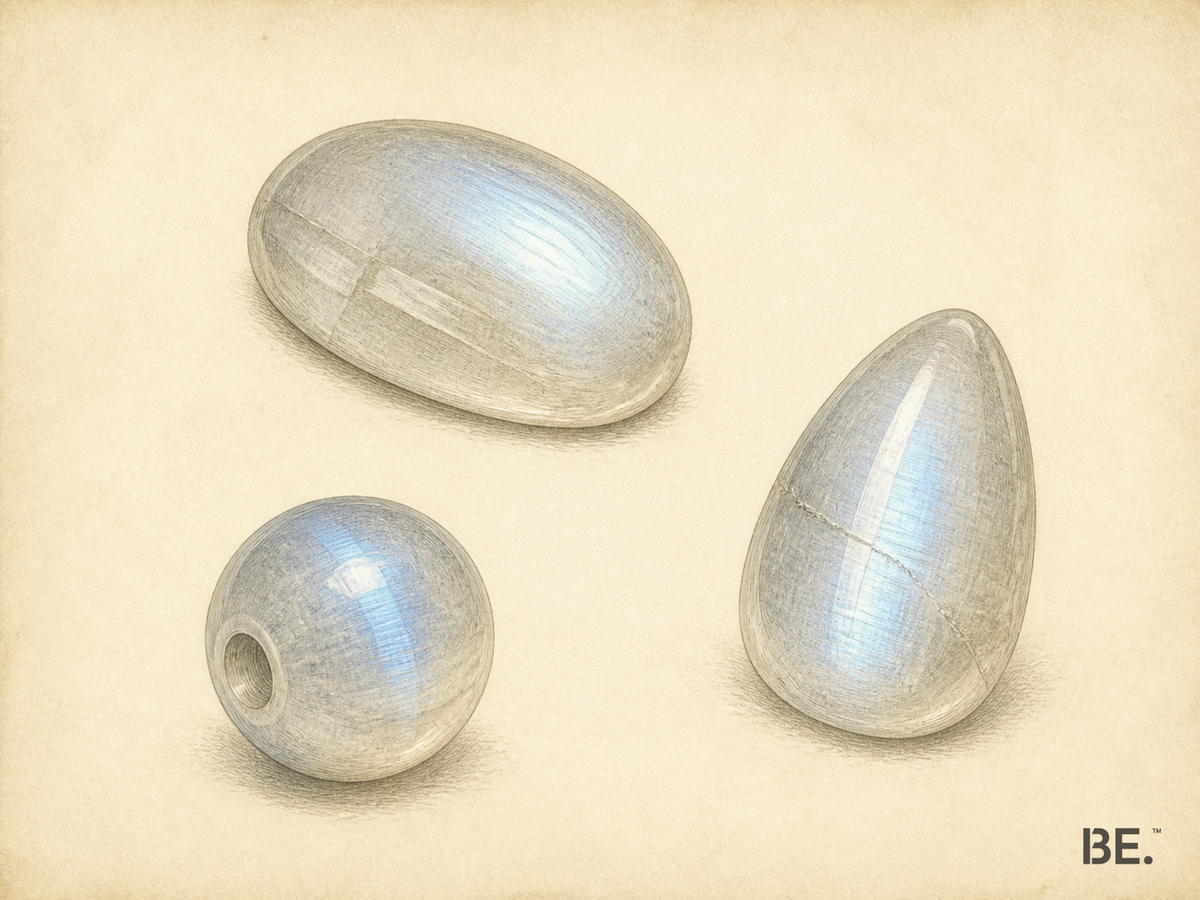
Quality observation is not identification
Moonstone belongs to the feldspar field, where trade names and mineral names do not always align neatly. GIA notes that material sold as “rainbow moonstone” is technically transparent labradorite, a plagioclase feldspar. Recent gemmological research also cautions that terms such as adularescence, labradorescence and peristerescence are tied to identified gem materials. If a feldspar has not been positively identified, “iridescence” is the safer descriptive term.
That distinction changes what a buyer can responsibly say. A rotating video can show how a light field moves. A close photograph can show polish, chips and some surface-reaching fissures. Neither can replace mineral identification or treatment testing. A seller’s lot record is useful disclosure; an independent laboratory report answers a different question.
Evaluate the moving light, not a single flash
The optical effect associated with moonstone comes from light interacting with very fine feldspar structures. It appears to float or travel as the stone, light or viewer moves. Commercially valued moonstone often shows a vivid, well-centred light field that can be seen through a useful range of angles rather than at one narrow position.
Ask for an unfiltered rotation video in diffuse neutral light. Watch each bead through a full turn. A strong frame at the start of the video matters less than whether the effect travels cleanly, remains visible over more than a moment and is distributed across the strand.
Check coverage and viewing range
A centred effect is easier to read on a cabochon or bead than light that disappears at an edge. Curved, well-polished surfaces can make iridescence visible over a wider angle. On a strand, quality also includes the editing of the group: one exceptional bead does not compensate automatically for many beads with weak or poorly oriented light.
Do not make blue the only standard
Vivid blue sheen can command a premium, especially in near-colourless, translucent-to-transparent material. It is still only one part of quality. White, silver, yellow or other optical colours may be legitimate, and bodycolour is not irrelevant. Judge whether the effect is distinct, mobile and suited to the material being represented—not whether every bead matches a heavily edited blue reference image.
Read bodycolour, clarity and cut together
Bodycolour establishes the field through which the optical effect is seen. Near-colourless material can make a blue light field appear especially crisp, while warmer or more opaque material produces a different result. Describe that result accurately rather than treating one appearance as the only valid moonstone.
Clarity also needs context. Cleaner material can make the effect easier to see, but moonstone may contain characteristic stress-related inclusions sometimes described as “centipedes”. Their presence does not prove natural origin. Their absence does not prove synthesis. What matters for wear is whether an inclusion reaches the surface, crosses a drill hole or creates an obvious structural weakness.
Cut must serve the optical structure
Moonstone is commonly fashioned as cabochons and beads because curved surfaces can display the optical effect across movement. A cut that is too flat, poorly oriented or unevenly polished may lose the light field. On a bead strand, inspect whether holes are centred, bead profiles are even and the polish remains consistent around the full circumference.
Inspect durability, not just beauty
Moonstone is about Mohs 6 to 6.5, but hardness measures resistance to scratching rather than resistance to every kind of damage. GIA describes moonstone as having poor toughness and two cleavage directions. A hard knock can chip or split a bead even when its surface has resisted ordinary abrasion.
Pay particular attention to drill holes, edges and any fissure that reaches the surface. A softly internal inclusion and an open fracture are not the same risk. Look for fresh chips, powdery edges, rough drill-hole rims, uneven polish and fractures that open or catch the light sharply. For cleaning, use warm soapy water and a soft cloth; avoid steam, ultrasonic cleaning, high heat and thermal shock.
Moonstone quality observation table
| Observation | Stronger quality read | Durability concern | What it cannot prove |
|---|---|---|---|
| Moving light | Distinct light field that travels as the bead turns | None by itself | Mineral species or natural origin |
| Viewing range | Effect remains readable through a useful range of angles | A very narrow angle may signal poor orientation, not damage | Treatment or geographic origin |
| Bodycolour | Even, accurately represented colour that supports the optical effect | Unusual colour alone is not damage | That blue or white material is genuine moonstone |
| Transparency and clarity | Appropriate transparency with the optical effect still distinct | Surface-reaching fissures can weaken a bead | That a clean bead is synthetic or an included bead is natural |
| Cut and orientation | Curved, balanced form with light positioned where movement reveals it | Very thin areas or poor drilling may be vulnerable | Mineral identity |
| Polish | Even lustre without dull patches, flat spots or coarse abrasion | Rough drill rims and chips can grow under wear | Treatment status |
| Strand matching | Considered rhythm of light, bodycolour, bead size and polish | One damaged bead remains a structural issue | That every bead came from one mine or deposit |
| Documentation | Specific material, lot and treatment disclosure; report where warranted | Missing disclosure increases purchasing uncertainty | Visual beauty; a report and a quality judgement answer different questions |
Ask for evidence that matches the claim
For appearance, request exact-item photographs and an unedited rotation video under neutral light. For durability, request close views of drill holes and any visible fissures. For identity or treatment, ask what testing or supplier disclosure supports the wording. For geographic origin, require evidence specific to that claim; sheen colour is not a map.
Filled moonstone beads have been documented in the gemmological literature. That fact does not imply that a particular strand is filled. It shows why a beautiful photograph cannot rule out treatment and why treatment wording should stay tied to documented evidence.
A practical buying sequence
- Confirm the seller’s exact material name and treatment disclosure.
- View the exact item or current lot in neutral, moving light.
- Compare strength, movement and viewing range across the whole strand.
- Inspect bodycolour, clarity, drill holes, chips, fissures and polish.
- Check construction, size, care guidance, returns and any supporting report.
- Buy the appearance you can observe; reserve identification claims for evidence that can support them.
Frequently asked questions
Q1. What makes moonstone high quality?
High-quality moonstone usually combines a distinct, mobile light effect with a useful viewing range, appropriate bodycolour and transparency, considered cutting, even polish and no serious surface-reaching damage. These are quality observations, not a laboratory identification.
Q2. Is blue sheen always better?
Vivid blue sheen can command a premium, especially in cleaner, near-colourless material, but it is not the only legitimate appearance. Strength, movement, viewing range, bodycolour, cut and condition must be read together.
Q3. Do cracks prove that moonstone is genuine?
No. Some moonstone contains characteristic internal stress features, but inclusions and fissures are not proof of identity. A surface-reaching fracture may instead be a durability concern. Mineral identity requires appropriate testing or reliable documentation.
Q4. Can a photograph prove that moonstone is natural?
No. Photographs and videos can support an appearance assessment, but they cannot reliably establish natural versus laboratory-grown origin, feldspar species, treatment or geographic source. Those claims need evidence suited to the question.
Q5. Is rainbow moonstone technically moonstone?
“Rainbow moonstone” is a trade name commonly used for transparent labradorite, a plagioclase feldspar, rather than classic alkali-feldspar moonstone. The seller should disclose the material instead of relying on the trade name alone.
Q6. Can moonstone be worn every day?
It can be worn regularly with care, but it is not an impact-proof material. Remove it for exercise, sleep, bathing and manual work; protect it from knocks, heat and thermal shock; and clean it with warm soapy water rather than steam or ultrasonic equipment.
References
- GIA — Moonstone Quality Factors
- GIA — Moonstone Buyer’s Guide
- GIA — Moonstone Description
- GIA — Moonstone Care and Cleaning
- Gems & Gemology — Structures Behind the Spectacle
- Gems & Gemology — Infrared Spectroscopic Study of Filled Moonstone
- Gems & Gemology — New High-Quality Rainbow Moonstone from Madagascar
- Smithsonian National Museum of Natural History — Moonstone
Field Notes.
One stone at a time: its geology, and how to read quality. The Stone Buying Checklist comes with your first email.
By subscribing you agree to receive emails from BE. Unsubscribe anytime.
Sent. Check your inbox.