
Shop by stone · Quartz
Tiger’s Eye
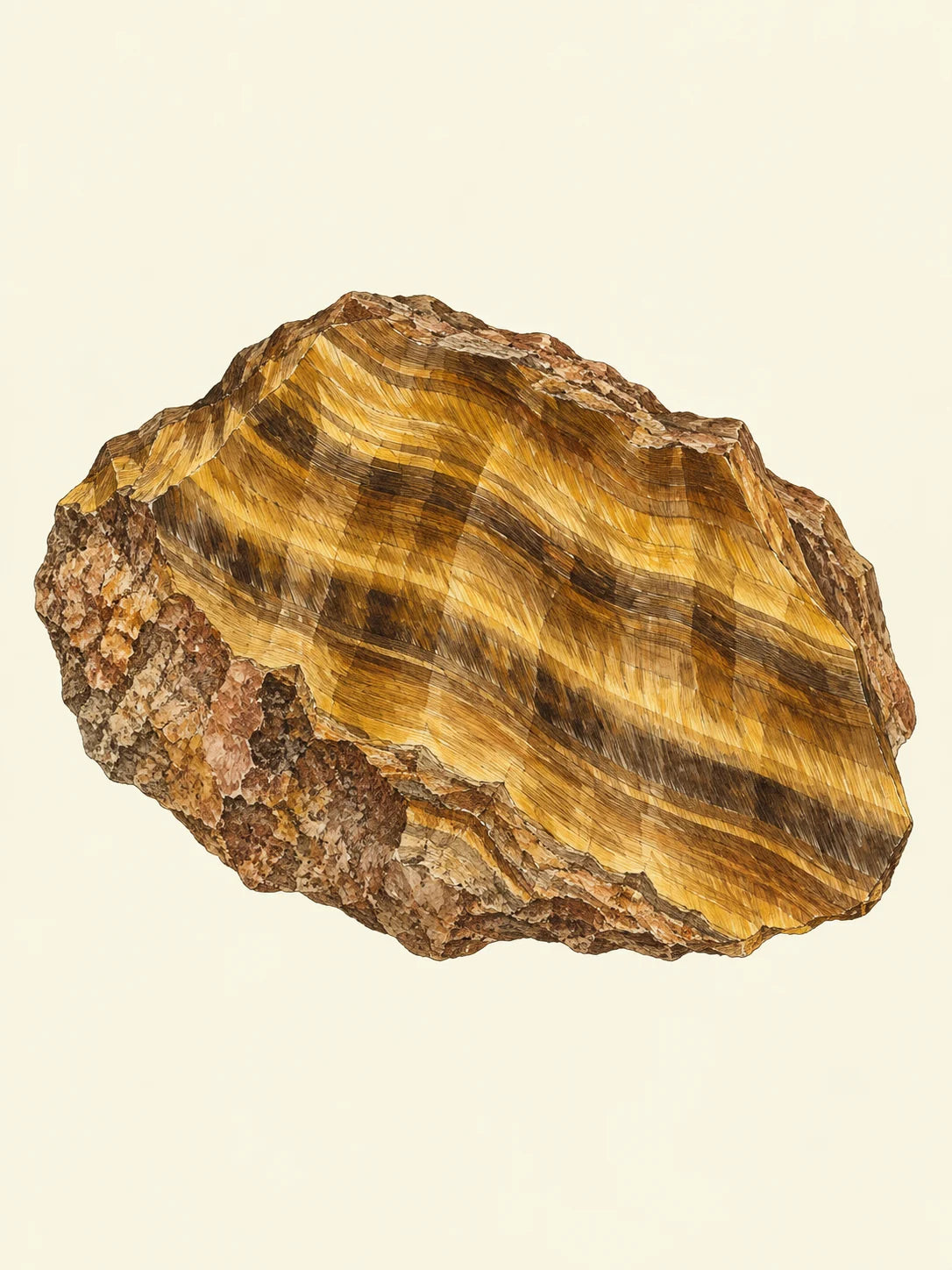
Fine mineral fibres inside quartz catch the light as the stone turns.
- Material
- Chatoyant quartz with aligned fibrous inclusions
- Principal host
- Quartz, SiO₂
- Structure
- An aggregate of quartz crystals
- Optical effect
- Chatoyancy: a moving band of reflected light
Tiger’s Eye
Pieces in this stone.
One tiger’s eye necklace, in 4mm beads, from €189. The tiger’s eye comes from the Prieska area of South Africa’s Northern Cape and is untreated, with no heat, dye or irradiation, and every piece ships with a Stone Origin Record. At Mohs 6.5 to 7 it suits daily wear; a hard knock can chip a bead, so store it apart from harder jewellery.


On this page
How it formed
Tiger’s eye begins with quartz and an iron-rich fibrous mineral called crocidolite. In studied South African material, they grew together in openings within the rock. Water carried the dissolved ingredients into a fracture, where new quartz and fine amphibole fibres could grow.
As the opening filled, movement in the surrounding rock could split it again. More mineral-bearing water entered. The next growth sealed the new space, sometimes with the fibres slightly offset from the earlier ones. Repeated opening and filling built the banded texture.
The blue fibres could then change through weathering. Iron oxides and hydroxides developed as the amphibole altered, giving golden tiger’s eye its brown and yellow colours. Where the fibres remain less altered, the quartz can show the dark blue of hawk’s eye.
The moving sheen comes from the aligned mineral fibres. The quartz around them consists of many crystals. Under a small light, different areas brighten as the stone turns and brings their fibres into the reflecting angle.
This crack-and-seal interpretation was proposed for examined South African specimens. Older accounts describe quartz replacing crocidolite. The two accounts describe different growth histories; a surface photograph alone cannot establish which history a particular piece records.
How to look at yours
Turn a polished stone slowly beneath one small light. Follow the bright band across the surface, then move into diffuse daylight to see its body colour. Gold, brown and blue-grey areas may share the same piece.
Compare neighbouring bands. Their sheen can brighten at different angles because the internal fibres follow different directions. The shape and orientation of a cut also affect the reflection.
Treat colour and treatment as separate observations. A golden or blue appearance occurs in natural material, but the colour of an individual piece needs its own treatment record. The moving band of light identifies an optical effect; it does not certify origin or treatment.
One way to read it
One way to read this: a crack opens in the rock. Water enters, and quartz and fine mineral fibres grow together, gradually filling the gap. The rock moves again, opening another space for growth. Small shifts between successive growths leave bands within the stone. As you turn it, light catches the aligned fibres and moves across its surface.
This reading follows the crack-seal model proposed for studied South African specimens. Tiger’s-eye formation remains debated.
The name
The English name tiger-eye is in print at least as early as 1888, and a 1912 museum guide already separated tiger-eye from hawk’s-eye. The eye-like band of light seen across a suitably cut surface is what gemmologists call chatoyancy.
The dark blue appearance is called hawk’s eye or falcon’s eye. These are names for quartz appearances. Pietersite also shows a fibrous sheen, but its silica is chalcedony and its texture needs a separate geological account.
A field study near Prieska also records variegated tiger’s eye, where yellow and blue areas meet within the same material. Red colour can be produced by heating. These descriptions cover appearance and treatment, with no fixed worldwide count of varieties.
Tiger iron includes tiger’s-eye material within iron-rich banded rock. Its jasper and iron-oxide layers make it a different comparison from colour alone.
Tiger’s Eye: questions before you buy
Is your tiger’s eye natural, or dyed or heated?
Natural and untreated. Golden tiger’s eye takes its colour from iron oxides that formed as blue crocidolite fibres weathered inside the quartz. Heating turns it red, and some tiger’s eye on the market is dyed. Our lot from the Prieska area of South Africa’s Northern Cape is recorded on its Stone Origin Record: no heat, no dye, no irradiation.
What makes the band of light move?
Fine mineral fibres inside the quartz, lying in a shared direction. They reflect light in a narrow line across the fibres, an effect called chatoyancy. As you turn a bead the line slides over it, and neighbouring bands brighten at slightly different angles because their fibres do not run quite the same way.
What is the difference between tiger’s eye and hawk’s eye?
How far the fibres have changed. Where the iron-rich crocidolite fibres stayed largely unaltered, the quartz shows a dark blue-grey: hawk’s eye. Where they weathered into iron oxides and hydroxides, it turns gold and brown: tiger’s eye. Some pieces carry both colours side by side. Our necklace is the golden form.
Does every bead look the same?
No. Each 4mm bead cuts the fibres at its own angle, so one shows a sharp golden line, the next a broader brown band, and some carry darker stripes. We select the lot for an even golden-brown across the strand, and the light still moves a little differently on every bead.
Stone Explorer
Golden tiger’s eye and blue hawk’s eye.
Compare · Formation · Evidence
OPEN STONE EXPLORER →From the Journal