
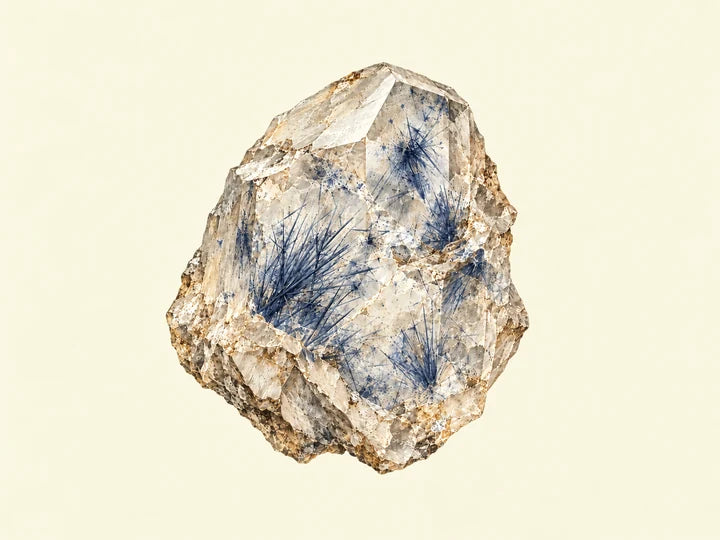
Mineral record
Dumortierite
Dumortierite forms under heat and pressure that would reshape other minerals.
- Mineral
- Dumortierite, an aluminium borosilicate
- Ideal formula
- Al₇BSi₃O₁₈ (dumortierite); SiO₂ (quartz)
- Crystal system and hardness
- Orthorhombic, Mohs 7 to 8.5 for dumortierite; trigonal, Mohs 7 for quartz
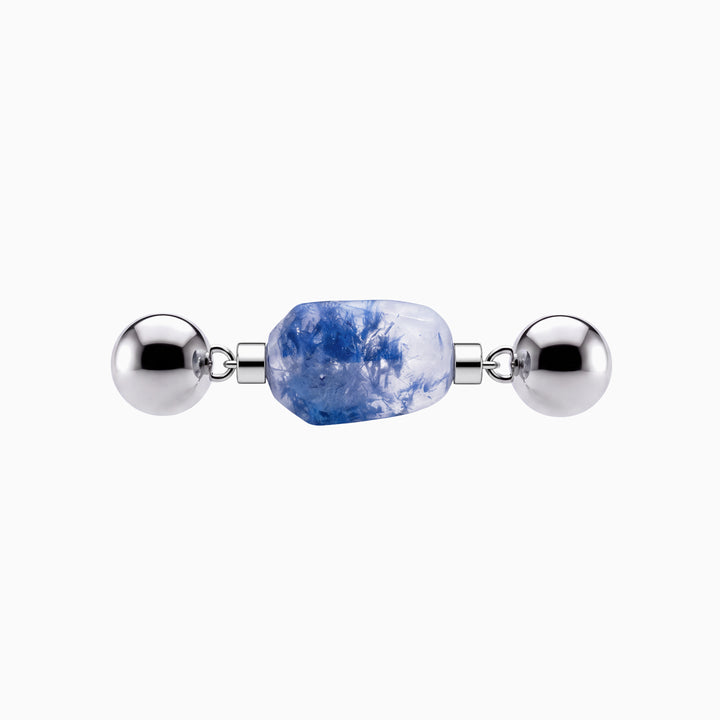
Same colour family
Other blues.


On this page
How it formed
In 2007, geologists L. V. Ranaweera, L. R. K. Perera and Yoshikuni Hiroi published their study of blue dumortierite at Veheragala quarry in Sri Lanka. Thin veins ran through the banded gneiss, some following its foliation, others cutting across it. Within the veins, fine dumortierite needles were enclosed in quartz and feldspar. Those small crystals helped the researchers work backwards through the rock’s formation.
The researchers interpreted these enclosed needles as an early generation, possibly formed as boron-bearing granitic magma crystallised at depth. Quartz, feldspar and dumortierite grew within the veins. A needle incorporated into one of the larger crystals could remain there as an inclusion, preserving a small part of that earlier mineral assemblage. Other dumortierite in the same rocks had different relationships to its neighbours.
Inside quartz, the two minerals kept separate structures. Dumortierite brought aluminium and boron into a framework that also contained silicon and oxygen. Quartz was silicon dioxide. One could form a fine needle while the other built the body around it. The needle still had its own composition and outline after it became part of the larger stone.
When a growing crystal traps another mineral, the enclosed crystal may already have been present, or the two may have grown during overlapping stages. In either case, a needle caught during growth had to be there by the time the quartz enclosing it formed. Its position gives a relative order to the events: a small crystal within a later enclosing volume of quartz.
Quartz can also bury a former growth surface. Small crystals deposited on a face can be enclosed when more quartz grows over them, leaving their arrangement inside the enlarged crystal. The outer faces move outwards as the crystal grows; the included minerals can trace an earlier outline within it. Gemmologists call that internal outline a phantom, because a former shape remains visible inside the newer quartz.
In 2015, a separate group of needle-bearing rock crystals reached GIA’s Carlsbad laboratory. Nathan Renfro, Ziyin Sun and John Koivula described blue clusters and, in one specimen, pale needles on a phantom plane. Their view through the clear host connected individual crystals with the surface along which some of them lay.
Raman analysis identified both the blue and pale needles as dumortierite. Under polarised light, the blue needles showed strong variation from blue to colourless. Some also had brown staining along the boundary where needle and quartz met. The authors described that staining as a later mineral deposit at the interface, another event preserved within the stone.
Chemical analysis gave them another way into the needles. The pale inclusions contained more magnesium than the blue ones. The authors proposed that magnesium could affect how titanium compensated electrical charge in the structure, limiting the formation of the blue colour. This was their explanation for the samples they had measured. Small differences in the chemistry of the same mineral could be carried into the stone as different colours.
The group included a 15.47-carat faceted stone with blue inclusions. Cutting gave its quartz host a new outline. In a bead made from needle-bearing quartz, shaping and polishing also remove part of the outer stone. Needles retained inside remain enclosed, so the rounded bead carries fragments of the mineral growth that preceded the cutter’s work.
How to look at yours
Hold the strand in daylight and look at the colour across a whole bead. If you see paler areas, compare them with the deeper blue and follow their boundaries as you turn the bead slowly. Notice the highlight moving across the polished curve, then look again at the markings beneath it. Compare the next bead: does the colour look even, or do the visible markings differ?
Dumortierite also occurs with quartz in blue-and-white rock. In a specimen examined by gemmologists, the two minerals formed an uneven granular pattern: pale quartz grains lay among the blue dumortierite. If your bead shows mottling, look at the size and edges of those marks; if its colour appears even, notice how evenly it covers the bead. First look at the whole bead on the wrist, then examine any visible detail across its curved surface.
One way to read it
Dumortierite forms under heat and pressure that would reshape other minerals. Inside clear quartz, millions of blue needles lock into a mesh so fine that the crystal holds a single, dark hue from edge to edge. Look into the stone and there are no lines to trace, only the dense weave of the mineral itself, solid throughout.
Stone Explorer
Dumortierite is coming to Stone Explorer
Until then, see the stones already compared side by side.
OPEN STONE EXPLORER →From the Journal