Search for “black rutilated quartz meaning” and the first page of results will offer you protection, grounding, and a dozen other claims that have nothing to do with the stone in your hand. That is not what this article is about.
This is a mineralogical reading of black needle quartz — what the dark inclusions actually are, how they formed, why they look the way they do, and what you can learn about a stone’s geological history simply by looking at it closely. If meaning exists in a mineral, it lives in structure, not in intention.
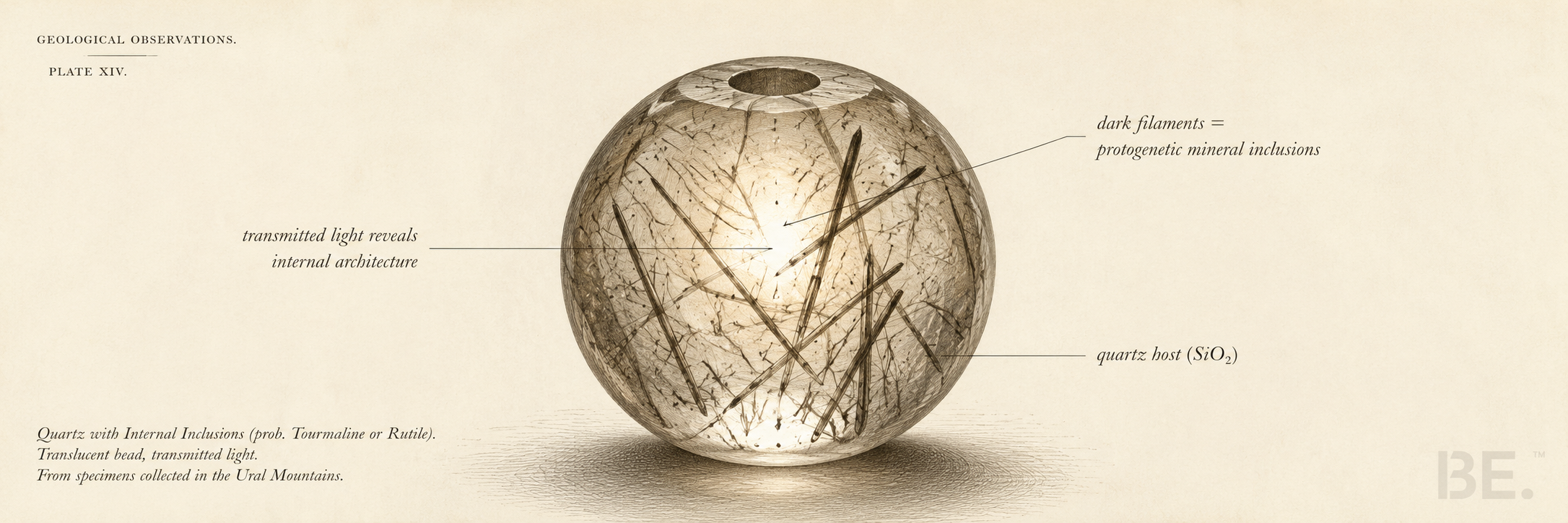
Every inclusion in quartz is a fossil record of the conditions under which the crystal grew. The dark needles in so-called “black rutilated quartz” are no exception. Three observable features — direction, thickness, and colour — each correspond to a specific geological variable.
Inclusions do not orient themselves randomly. They follow the crystallographic axes of the host quartz or the stress geometry of the surrounding rock at the time of formation. Parallel needles suggest a stable, directional stress field during growth. Chaotic, multi-directional sprays suggest a more turbulent environment — rapid pressure changes, shifting fluid chemistry, or multiple phases of crystal growth overlapping in time.
Fine, hair-thin inclusions typically indicate that the inclusion mineral precipitated slowly, in a thermally stable environment. Thick, blunt needles suggest faster crystallisation, often at higher temperatures or in fluid-rich conditions where mineral-saturated solutions could deposit material quickly. The aspect ratio (length to width) of each needle is, in effect, a speedometer of geological time.
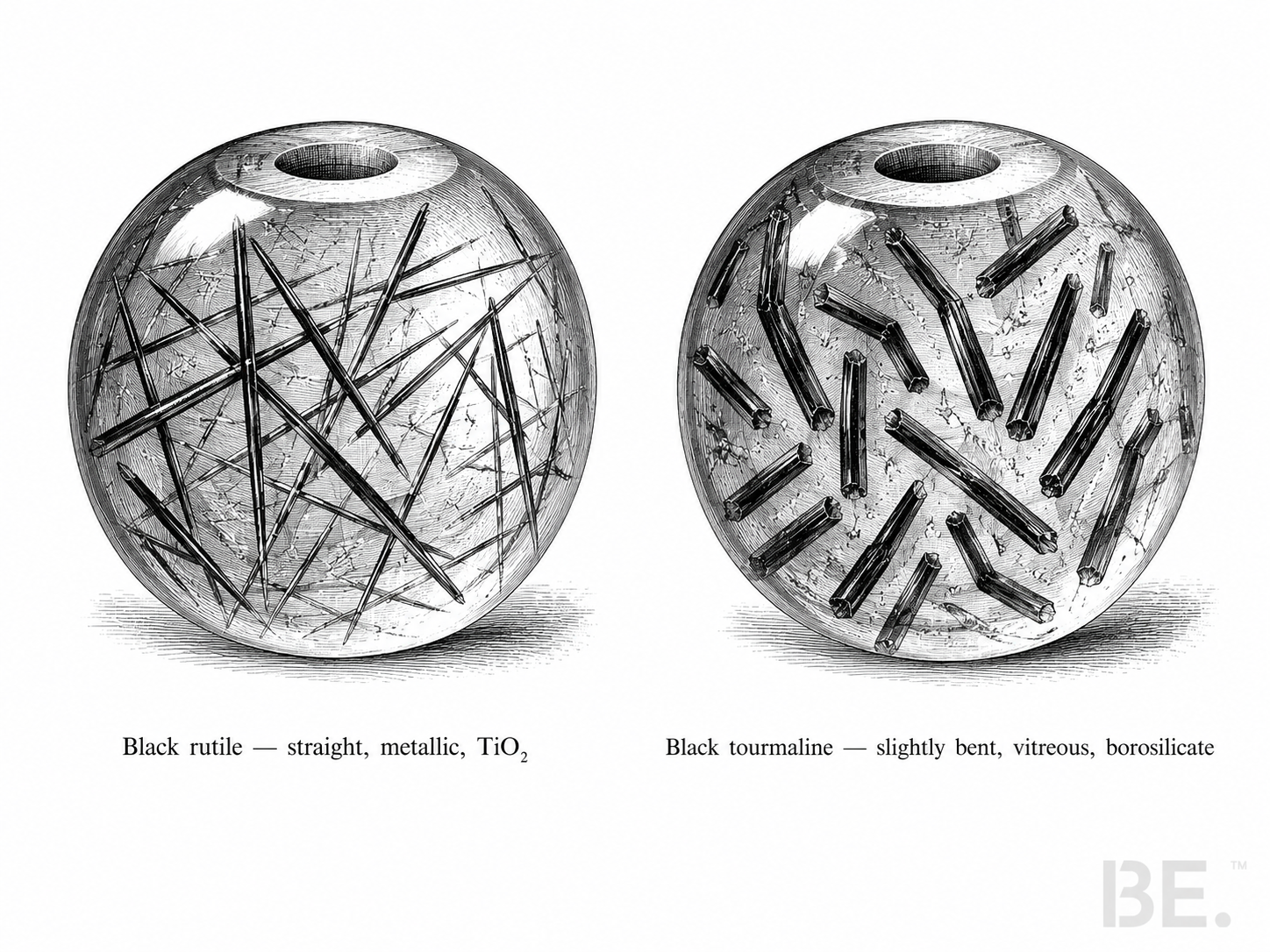
This is where the trade name “black rutilated quartz” becomes misleading. True rutile (TiO2) is typically golden, reddish-copper, or occasionally silver. When the needles appear black, the inclusion mineral is usually one of the following:
| Inclusion Mineral | Chemical Formula | Typical Appearance | Distinguishing Feature |
|---|---|---|---|
| Schorl (black tourmaline) | NaFe3Al6(BO3)3Si6O18(OH)4 | Opaque black rods, sometimes striated | Triangular cross-section under magnification |
| Ilmenite | FeTiO3 | Metallic black plates or blades | Sub-metallic lustre, often flat rather than acicular |
| Dark rutile | TiO2 | Very dark brown to near-black, thin needles | Adamantine lustre; rarely truly black, more deep brown |
| Actinolite (dark variety) | Ca2(Mg,Fe)5Si8O22(OH)2 | Dark green-black fibrous inclusions | Fibrous habit; green tint visible under strong light |
Without gemmological testing, many sellers label any dark-needled quartz as “black rutilated.” In strict mineralogical usage, only TiO2 inclusions qualify as rutile. The distinction matters if you care about what your stone actually contains.
A brief, honest comparison — because anyone researching this topic will encounter both frameworks.
| Popular Claim | Mineralogical Equivalent |
|---|---|
| “Protection stone” | Contains schorl tourmaline (an iron-rich borosilicate); Mohs hardness 7–7.5. Physically durable, yes. Metaphysically protective — no peer-reviewed evidence. |
| “Grounding” | Dark inclusions absorb light, reducing transparency. This is optical physics (Beer–Lambert law), not a spiritual property. |
| “Removes negative thoughts” | Not a documented property of any silicate mineral. Quartz is piezoelectric under mechanical stress, but that has no relevance to cognition. |
| “Rare and powerful” | Tourmalinated quartz is relatively common in granite pegmatites worldwide. “Rare” depends entirely on the quality and density of inclusions in a given specimen. |
Neither column is meant to mock the other. But if you want to know what your stone is rather than what you want it to be, the right column is the one grounded in observable, repeatable evidence.
You do not need a geology degree to read a black rutilated quartz bracelet. You need a loupe (10x is sufficient), decent light, and curiosity. Here is what to look for:
Each bead on a strand may tell a slightly different story. The quartz host grew in a dynamic environment, and the inclusions it captured are a cross-section of that environment’s chemistry across time. Reading a strand bead by bead is, in miniature, reading a geological timeline.
At BE., the word “meaning” appears nowhere in the product descriptions — and that is deliberate. Instead, every strand ships with a Stone Origin Card that documents the geological facts: mineral species, probable origin, Mohs hardness, and inclusion type. The intention is not to strip beauty from the stone. It is to locate beauty in what is actually there.
BE. grades its quartz strands on four material axes — the Crystal 4T framework:
This framework was built for people who find the mineral itself more interesting than what the internet says it can do for you. It does not tell you what to feel. It tells you what you are holding.
Another quartz variety. Another geological story.
In mineralogical terms, it refers to transparent quartz containing dark, needle-like inclusions — most often schorl tourmaline, ilmenite, or occasionally very dark rutile (TiO2). The “meaning” is structural: each inclusion is a physical record of the temperature, pressure, and chemistry present during the crystal’s formation. For a deeper look at the rutilated quartz family, see our rutilated quartz guide.
Many online sources attribute protective or grounding properties to this stone. These claims are not supported by mineralogical or materials science research. What is scientifically documented: quartz is piezoelectric (it generates a small voltage under mechanical stress) and its dark inclusions absorb specific wavelengths of light. Neither property has any established link to psychological or spiritual outcomes.
As a physical object, quartz with tourmaline inclusions has a Mohs hardness of 7–7.5, making it reasonably scratch-resistant and suitable for daily wear. The claim that it offers metaphysical protection is a cultural belief, not a material property. If durability is what you mean by “protection,” then yes — it is a robust stone for jewellery.
Clear (or golden) rutilated quartz contains titanium dioxide (TiO2) needles that transmit warm amber or copper-gold light. “Black rutilated quartz” usually contains a different mineral altogether — schorl tourmaline or ilmenite — which is opaque and absorbs light rather than transmitting it. The host crystal in both cases is the same: silicon dioxide (SiO2). The difference is in the inclusion, not the quartz.
Share:
Black Rutilated Quartz: Inclusions, Origins & How to Read a Strand
Blue Needle Quartz: Dumortierite Inclusions & What Makes It Rare