In one paragraphRose quartz is silicon dioxide (SiO2) coloured by submicroscopic pink dumortierite fibres suspended in the quartz host — a borosilicate inclusion, not a trace element. That is why most rose quartz is milky rather than gem-clear, and why prolonged sunlight fades the colour. True transparent pink crystals (known as pink quartz) are a separate and much rarer occurrence.
Rose quartz is one of those stones almost everyone has touched without ever looking closely. The standard cabochon — milky, pale pink, slightly cloudy — is so familiar that few buyers ask what is actually inside the glass. The answer turns out to be the most interesting part: the colour is not a trace impurity dissolved in quartz, it is a forest of submicroscopic pink fibres floating in it.
This guide unpacks what rose quartz really is, why some pieces show a six-rayed star while most do not, the difference between bulk rose quartz and the rare transparent pink crystal form, where the best material on the market is mined, and what to check on a strand before you commit.

What rose quartz actually is
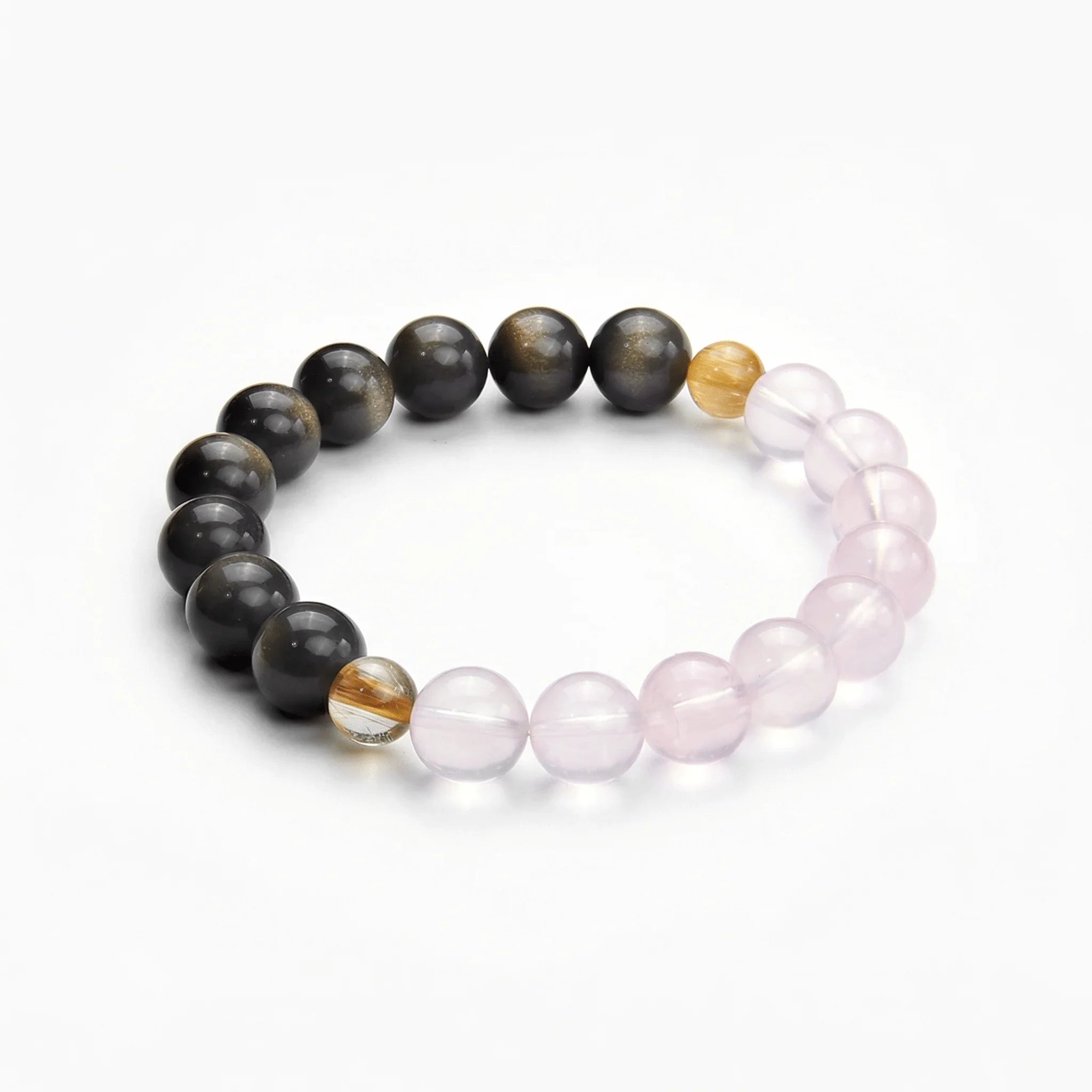
Rose quartz is macrocrystalline quartz: trigonal SiO2 with the same atomic lattice as clear quartz, amethyst and citrine. The chemistry of the host is unremarkable. What makes it pink is unusual: aligned nanofibres of dumortierite, a borosilicate mineral (Al6.5-7BO3(SiO4)3(O,OH)3), grew simultaneously with the quartz during a late hydrothermal stage. The fibres are only tens of nanometres thick — too small to see even under an optical microscope — but they absorb light in the green band and reflect pink.
This explanation, established by Goreva, Ma and Rossman at Caltech (2001) using transmission electron microscopy, replaced the older theory that titanium or manganese substitution caused the colour. The fibre model also explains two stubborn facts: rose quartz is almost always cloudy (because the fibres scatter light just like fog scatters headlights), and the colour fades under UV (because the dumortierite breaks down photochemically). Mohs hardness sits at 7, identical to other quartzes.
A separate, much rarer variety exists: transparent pink quartz crystals that grow as well-formed prisms. These are usually called pink quartz rather than rose quartz, and their colour comes from a different mechanism — aluminium and phosphorus substitution stabilised by natural radiation. Pink quartz crystals are far more sensitive to light than massive rose quartz and fade visibly within months of direct sun.
Why the colour varies
If the colour comes from a forest of nanofibres, the depth and quality of pink should track fibre density, fibre length, and how cleanly they are aligned. That is exactly what we see.
| Variety / appearance | Mechanism | What it tells you |
|---|---|---|
| Pale pink, milky | Low to moderate dumortierite fibre density | The standard market grade; consistent colour but very translucent rather than transparent |
| Medium to deep pink, milky | High dumortierite fibre density | Premium material from Brazilian Minas Gerais pegmatites; the colour reads pink even in low light |
| Star rose quartz (asterism) | Three sets of parallel dumortierite fibres at 60°, refracting a six-rayed star | The fibres are unusually long and well-aligned; visible only as cabochons under a single point light |
| Pink quartz crystals (transparent) | Al/P substitution stabilised by natural radiation — a different mechanism entirely | From a handful of Brazilian pegmatites; fragile colour, fades within months in sunlight |
| Peach to salmon tint | Trace iron oxide alongside the dumortierite | Often misnamed; technically still rose quartz, but skewed warm by Fe3+ |
Where the visible material forms
Rose quartz forms in granitic pegmatites — coarse-grained intrusions where late-stage hydrothermal fluids carry boron, aluminium and silica together. The dumortierite and quartz crystallise as a paired growth. Because pegmatites are localised, world supply concentrates in a handful of districts.
| Origin | Typical character | What to look for |
|---|---|---|
| Minas Gerais, Brazil (Galileia, Itinga, Coronel Murta) | The world reference — medium to deep pink, massive blocks up to tonnes | Saturated pink colour that holds in low light; the standard most other sources are graded against |
| Madagascar (Antsirabe district) | Pale to medium pink, very even colour distribution | Cleaner appearance than Brazilian material but usually a lighter tone; well suited to large beads |
| Namibia (Erongo region) | Pale pink with occasional translucent zones | Material is finer-grained; takes a glassier polish than Brazilian rose quartz |
| Maine and South Dakota, USA | Star rose quartz with unusually well-aligned fibres | The few sources of reliable six-rayed asterism; rarely seen in bead form |
| Pitorra mine, Minas Gerais (transparent pink quartz) | Small (cm-scale) transparent pink prismatic crystals | Only source of well-formed pink quartz crystals; sold as specimens, not strands |
Reading a rose quartz strand
Because rose quartz is rarely transparent, assessment is about colour tone, polish, and how evenly the dumortierite fibres are distributed through the strand.
- Colour saturation. Compare beads at the centre of the strand to beads at the ends. The pink should be visible from across a room, not just under direct light. A faint pink that disappears in shadow signals low fibre density.
- Bead-to-bead consistency. Massive rose quartz is cut from blocks; a well-graded strand pulls beads from the same colour zone. Wild swings from pale to deep on adjacent beads usually mean mixed material.
- Internal fractures. Rose quartz is brittle. Look for healing fractures (fingerprint-shaped) under a loupe; small ones are normal, long radial fractures are not.
- Polish quality. A glassy lustre is achievable on dense Brazilian material. Pale Madagascan rose quartz sometimes finishes with a slightly soft, satin lustre — not a defect, but worth noting.
- UV check at home. Compare a hidden bead (under the strand's clasp) to an exposed one after a year. Significant fade means the piece had a higher transparent-pink-quartz content than declared.
Trade names, decoded
Rose quartz attracts more naming inflation than almost any other quartz variety. Most of the trade vocabulary is descriptive rather than technical.
- Rose quartz. The default — massive, milky pink, dumortierite-coloured. The overwhelming majority of beaded material.
- Pink quartz. A separate, transparent crystal form coloured by Al/P substitution. Almost never strung as beads; if a vendor calls beads ‘pink quartz crystals’, ask for the source.
- Star rose quartz. Cabochon-cut rose quartz that shows a six-rayed asterism under a point light. Material from Maine and South Dakota is the most reliable source.
- Strawberry quartz. A separate stone — quartz with red hematite or lepidocrocite inclusions — sometimes sold next to rose quartz at colour-similar prices, but mineralogically distinct.
- Peach quartz / cherry quartz. Modern trade names. Peach quartz is usually rose quartz with iron; cherry quartz is almost always artificial glass and not a natural quartz at all.
Caring for rose quartz
The two real enemies of rose quartz are heat and prolonged ultraviolet light. Sustained sunlight on a windowsill or dashboard will fade a deep pink to pale over a year or two; the dumortierite fibres are not destroyed but the chromophore breaks down photochemically. Heat above about 250 °C can also drive colour loss. Soap and water are fine; ultrasonic cleaners are usually safe at Mohs 7 but avoid them if you can see internal fractures. Store rose quartz in a soft pouch out of direct light.
How BE. grades rose quartz
We grade rose quartz against the Crystal 4T system — Transparency, Tone, Texture and Trace — and pair each strand with the matching Stone Origin Card naming the source country and region (Galileia, Antsirabe and Erongo are recurring sources, and where the upstream supplier has disclosed a specific deposit the locality is recorded) and the colour mechanism (dumortierite-coloured massive material, not transparent pink quartz). Tone is judged under a standard 5000 K daylight bulb against a neutral grey card; we reject strands where bead-to-bead tone shifts by more than one Munsell step. Texture is checked under 10x for healed fractures and surface chatter.
Frequently asked questions
Q1.Why is rose quartz cloudy and not transparent?
Because the colour comes from billions of submicroscopic dumortierite fibres suspended in the quartz. The fibres are too small to see individually but they scatter light, which produces the characteristic milky translucency. Transparent pink quartz is a separate, much rarer variety with a different colour mechanism.
Q2.Does rose quartz fade in the sun?
Slowly, yes. The dumortierite chromophore degrades under prolonged UV, which is why a piece left on a sunny windowsill will read paler after a year or two. Daily wear and indoor light are not a concern. Pink quartz crystals fade much faster than massive rose quartz.
Q3.What is the difference between rose quartz and pink quartz?
Rose quartz is massive (no crystal faces), milky, and coloured by dumortierite microfibres. Pink quartz forms small transparent crystals and is coloured by Al/P substitution stabilised by natural radiation. The two come from different geological environments and are usually priced very differently.
Q4.What causes the star in star rose quartz?
Three sets of parallel dumortierite fibres lying at 60-degree angles to each other. When light hits a polished dome (cabochon) from a single point source, each fibre set reflects a bright line, and the three lines cross to form a six-rayed star.
Q5.Is Madagascan rose quartz better than Brazilian?
Different, not better. Brazilian material from Minas Gerais usually has deeper colour saturation; Madagascan rose quartz tends to be paler but more evenly distributed and slightly cleaner. The right choice depends on whether you want depth of colour or evenness.
Q6.How can I tell dyed pink quartz from real rose quartz?
Inspect a drill hole under a loupe — dye usually concentrates at fractures and hole edges as visible pink lines. Natural rose quartz colour is distributed evenly through the body. A simple acetone wipe also lifts most dyes.
References
- Mindat — Rose quartz data
- GIA Gems & Gemology — Quartz varieties
- Wikipedia — Rose quartz
- Goreva, J.S., Ma, C., Rossman, G.R. (2001). Fibrous nanoinclusions in massive rose quartz. American Mineralogist 86, 466-472.
- Webster, R. (2002). Gems: Their Sources, Descriptions and Identification, 5th ed. Butterworth-Heinemann.
- Schumann, W. (2009). Gemstones of the World, 4th ed. Sterling.
Share:
Prehnite Guide: Mineral Origin, Inclusions & Jewellery
Natural vs Heated Citrine: A Material-First Honest Look