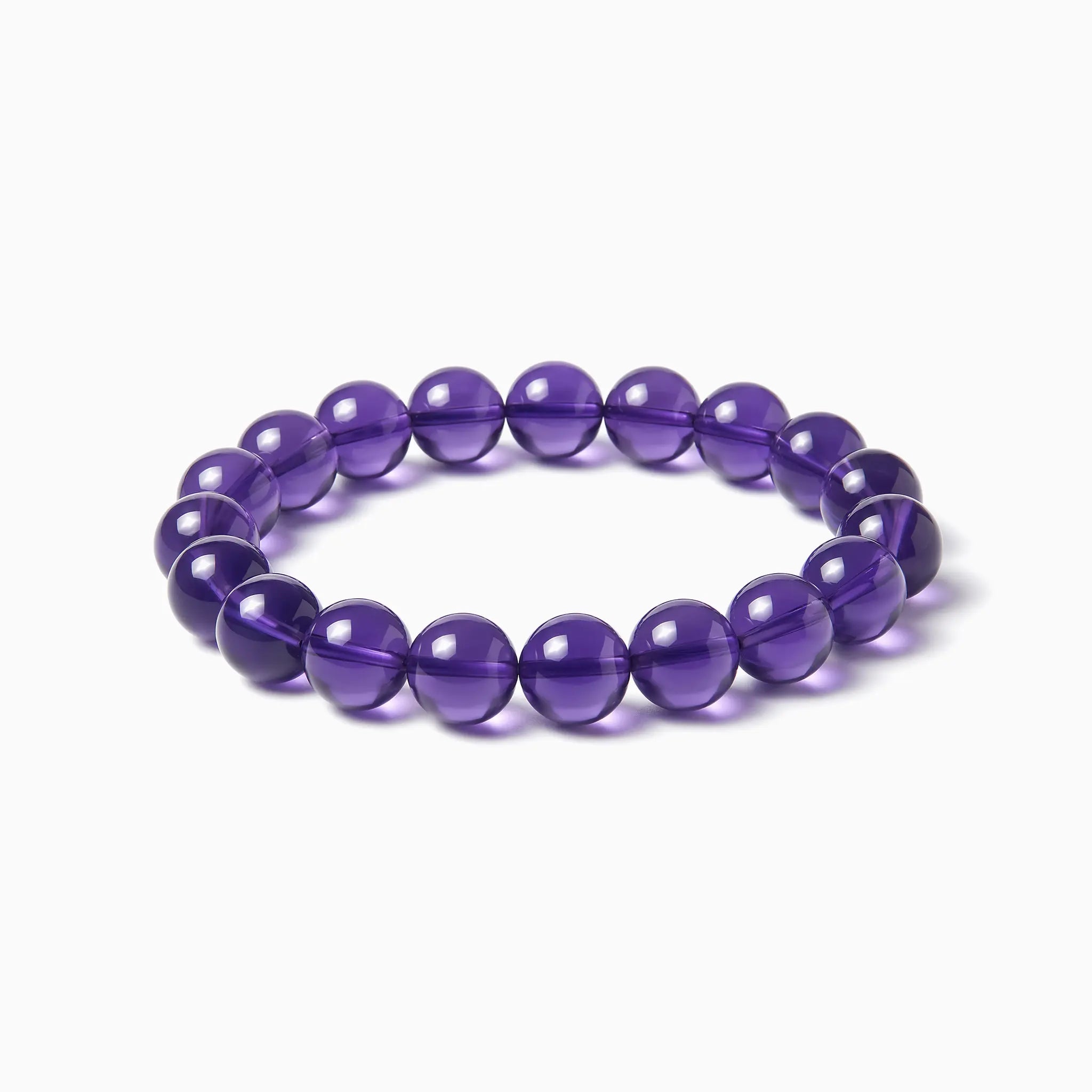
In one paragraphAmethyst is the purple variety of quartz (SiO2), coloured by trace iron in the crystal lattice activated by natural gamma radiation. Caring for amethyst is, materially, surface care: remove skin oils and dust, store it away from harder stones, and keep it out of direct sun — the colour fades under prolonged UV. The word cleanse is also used in ritual contexts; that is separate from material care and outside the scope of this guide.
Amethyst sits at Mohs 7. It is harder than steel, harder than window glass, and easily scratches calcite, fluorite, opal, and most pearl. It is also softer than topaz, spinel, sapphire, and diamond, and will scratch if stored loose with any of them. Most amethyst care is about managing those two facts — plus keeping the colour from fading in the sun. The rest is housekeeping.
This guide covers physical cleaning of an amethyst surface, storage practices that protect it from contact damage, and what UV does to the colour over time. It does not address ritual cleansing, charging, or any other metaphysical procedure — those traditions exist independently and use the same word for a different idea.
What amethyst actually is
Amethyst is single-crystal quartz with traces of iron substituting for silicon in the SiO4 tetrahedral lattice. The iron itself is colourless; what produces the violet hue is an Fe4+ centre formed when natural gamma radiation (usually from nearby uranium- or potassium-bearing rock) knocks an electron loose from Fe3+. Heat reverses the process — above roughly 200°C the colour fades, and above 400°C it usually shifts to citrine yellow. Sustained UV does the same thing more slowly.
Most amethyst on the market comes from hydrothermal cavities in basaltic flows: Brazil (Rio Grande do Sul), Uruguay (Artigas), Zambia (Kariba), and Bolivia (Anahí, where it grows alongside citrine as the bicoloured material called ametrine). The Bolivian and Uruguayan material is typically the deepest in colour; Brazilian amethyst ranges from pale lavender to inky violet depending on the deposit.
Surface cleaning: what works, what to avoid
For everyday cleaning of an amethyst strand or pendant, the procedure is short. Skin oils and lotion residue are the main culprits, and warm water with a drop of mild dish soap removes both.
| Method | When to use | What to avoid |
|---|---|---|
| Warm water + mild soap | Routine cleaning; weekly if worn daily | Hot water (over 40°C may stress glued settings) |
| Soft brush | Cluster geodes, raw points with crevices | Stiff bristles (scratch polished surfaces) |
| Microfibre cloth | Final dry; removes water spots | Paper towels (mildly abrasive) |
| Ultrasonic cleaner | Generally safe for solid amethyst | Heat-treated or fracture-filled stones (vibration can crack) |
| Steam cleaner | Avoid | Thermal shock; not recommended for any quartz |
Avoid bleach, ammonia, acetone, and acidic jewellery dips. None of these dissolves quartz, but they degrade silver and copper settings, dissolve glue holding stones into bezels, and dull surrounding metals over time.
Storage: surface contact is the real risk
Quartz is hard, but harder things scratch it, and softer things get scratched by it. A strand of amethyst stored loose in a jewellery box with topaz, sapphire, or diamond pieces will eventually show abrasion. Stored against opal, pearl, or turquoise, the amethyst will scratch them.
- Separate by hardness. Use individual soft pouches or a compartmented box with fabric dividers.
- Keep dry. Quartz is stable but the silver, brass, or thread of a strand is not — humidity tarnishes metal and weakens elastic cord.
- Avoid loose-bagging clusters. Raw amethyst clusters have fragile point tips; bag them individually or rest them on padded trays.
- Out of direct sun. Window-side display fades the colour over months to years. A drawer, shelf, or interior wall is fine.
The UV question: why amethyst fades
The Fe4+ colour centre that gives amethyst its violet is sensitive to high-energy photons. Sustained ultraviolet exposure — sunlight through a window over months, or a UV display cabinet light — will gradually shift it back toward colourless or pale yellow. The rate varies by material: some Brazilian amethyst fades noticeably within a year of direct window light; Uruguayan and Zambian material with deeper saturation tends to hold longer but is not immune.
If a strand or cluster is part of daily wear (and therefore mostly out of strong UV inside clothing or under sleeves), the question is rarely practical. For display pieces, treat sun exposure the way you would for watercolour or photographic prints: indirect light only.
How BE. thinks about amethyst care
BE.’s Crystal 4T framework grades a strand on tone, transparency, texture, and terroir at the point of selection. After that, care is the wearer’s. The recommendation is straightforward: rinse occasionally, dry properly, store separately, and keep it out of direct sun. The strand keeps the depth it was selected for.
Frequently asked questions
Q1.How often should I clean amethyst?
If worn daily, a rinse every one to two weeks is enough. For occasional wear, clean when it looks dull or has visible residue. Cluster pieces on display only need dusting.
Q2.Can amethyst go in an ultrasonic cleaner?
Solid, untreated amethyst usually tolerates ultrasonic cleaning. Avoid it if the stone is fracture-filled, dyed, glued into a setting with epoxy, or paired with softer co-stones (opal, pearl).
Q3.Why does my amethyst look lighter than when I bought it?
UV fading. Sustained sunlight bleaches the Fe4+ colour centre. Move it out of direct light; the colour will not return on its own, but further fading will stop.
Q4.What about salt water or salt burial for cleaning?
Salt water is fine for the quartz itself but corrosive to silver settings, base-metal findings, and the elastic or silk cord in a strand. Skip salt; warm soapy water is safer and more effective.
Q5.Is moonlight or sunlight a good way to clean amethyst?
Moonlight does nothing physically and is harmless. Sunlight fades the colour. Neither is a material cleaning method; both are ritual traditions used in other contexts.
Q6.Can I shower or swim with amethyst jewellery?
The quartz is fine; the rest of the piece usually is not. Soap residue dulls polish over time, chlorinated pool water corrodes silver, and elastic cord weakens with repeated wetting. Take it off.
References
- Mindat — Amethyst data
- GIA — Amethyst quality factors
- Wikipedia — Amethyst
- Mindat — Quartz
- Webster, R. (2002). Gems: Their Sources, Descriptions and Identification, 5th ed. Butterworth-Heinemann.
- Schumann, W. (2009). Gemstones of the World, 4th ed. Sterling.
Share:
Crystals and Calm: Colour, Habit & Material Reading
Citrine in Feng Shui: Cultural Reading & Material Truth