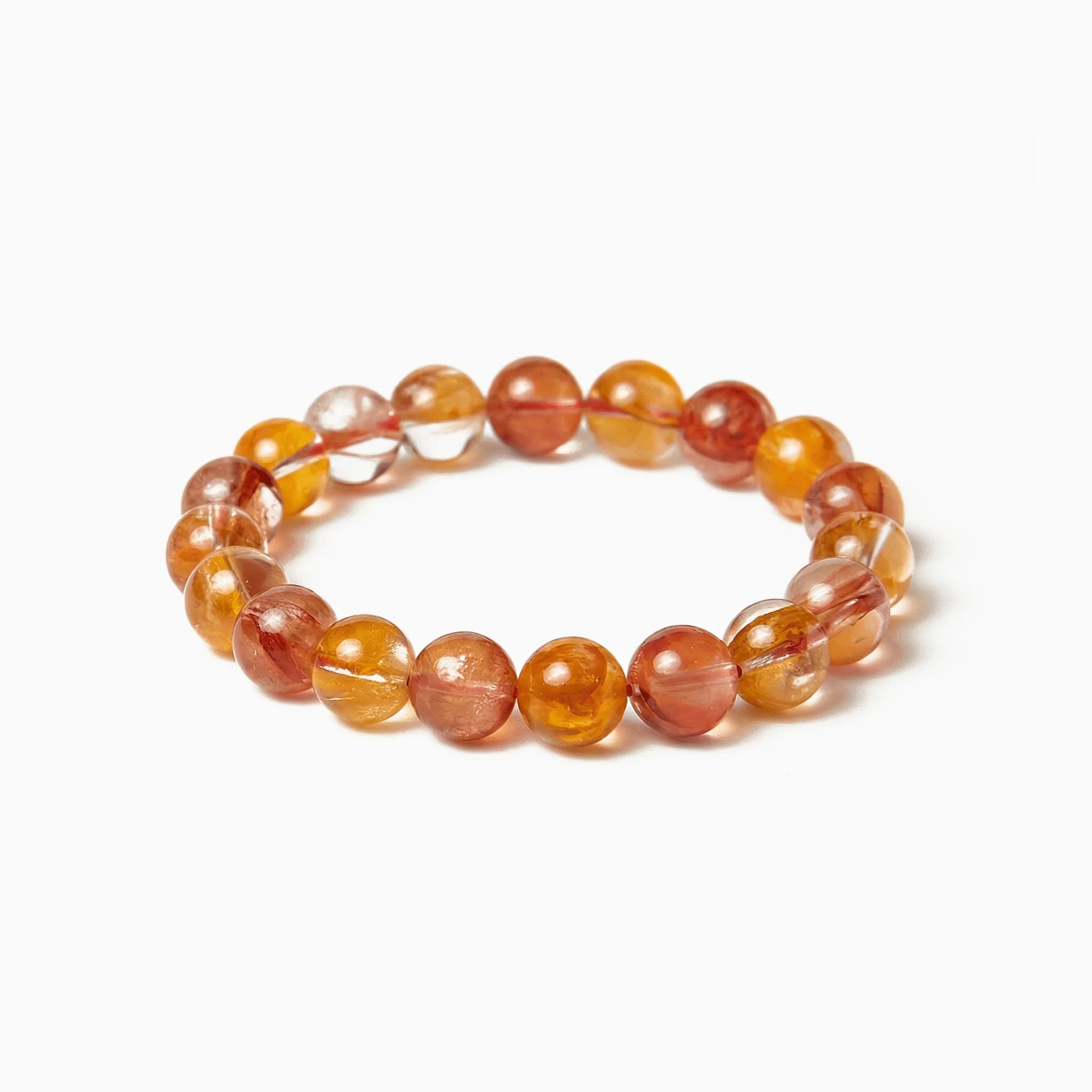
In one paragraphRed and orange crystals — red jasper, hessonite, hematoid quartz, sunstone, garnet, citrine, ruby — are mostly coloured by iron in two oxidation states (Fe2+/Fe3+), with chromium driving ruby and red spinel and manganese driving rhodochrosite and spessartine garnet. The hue spectrum from peach to deep crimson maps directly onto chromophore type and concentration.
Warm-toned stones share a single trick: an iron ion sitting somewhere in the lattice, absorbing light in the blue-green band so what reaches the eye reads orange, red or peach. Once you know what to look for, a hematoid quartz, a citrine, and a hessonite garnet stop looking similar and start looking like three very different mineral histories.
This guide opens up the warm half of the spectrum the way a gemmologist would — by chromophore first, mineral family second, deposit third. We list which ion produces which hue, where the major material comes out of the ground, and how to read a strand on the bench without leaning on trade-name marketing.

What this colour family actually is
The dominant chromophore in red and orange crystals is iron. Ferric iron (Fe3+) gives the orange of citrine and hessonite garnet and the brick-red of red jasper, hematite, and hematoid quartz inclusions; ferrous iron (Fe2+) and Fe2+–Fe3+ charge transfer drive the deeper reds of almandine and pyrope garnet. Chromium (Cr3+) is rarer and far more expensive: it is what makes ruby ruby, and gives red spinel its pigeon-blood saturation. Manganese (Mn2+) sits behind the pinks-to-reds of rhodochrosite and rhodonite and shows up again in spessartine garnet’s mandarin-orange.
The same iron ion at different concentrations produces a continuum. Trace Fe3+ in quartz reads as pale citrine; more iron, often combined with natural radiation, intensifies the hue toward orange. Iron oxide and oxyhydroxide inclusions — hematite, goethite, lepidocrocite — carried as dust or fibres inside chalcedony or quartz produce the deeper reds of jasper and hematoid quartz. The chromophore is the same element, but its host lattice and concentration set the final hue.
Warm spectrum: stone, chromophore, hue range
| Stone | Mineral family | Chromophore | Hue range |
|---|---|---|---|
| Red jasper | Chalcedony with hematite inclusions | Fe3+ (hematite) | Brick red, opaque |
| Hematoid quartz | Quartz + hematite/lepidocrocite inclusions | Fe3+ particles | Strawberry to rust |
| Hematite | Iron oxide (Fe2O3) | Fe3+ structural | Metallic grey-red |
| Citrine | Quartz (SiO2) | Fe3+, natural irradiation | Lemon to madeira orange |
| Sunstone | Plagioclase feldspar with copper or hematite inclusions | Cu metallic flakes (Oregon) or hematite | Peach to red with aventurescence |
| Hessonite garnet | Grossular garnet | Fe3+ + Mn2+ | Cinnamon orange |
| Spessartine garnet | Manganese aluminium silicate | Mn2+ structural | Mandarin to fanta orange |
| Almandine / pyrope garnet | Iron / magnesium garnet | Fe2+–Fe3+ charge transfer | Deep wine red |
| Rhodochrosite | Manganese carbonate (MnCO3) | Mn2+ structural | Soft pink to raspberry |
| Ruby | Corundum (Al2O3) | Cr3+ trace | Pure to bluish red |
| Red spinel | Magnesium aluminium oxide | Cr3+ trace | Pink-red to crimson |
Origins by stone
Top deposits set both visual character and supply curve. Red jasper comes mainly from India and Australia, with Western Australian deposits giving deeper, more uniform red. Sunstone is best known from the Ponderosa Mine in Oregon, where copper schiller gives the most saturated peach-to-red transparent material. Spessartine garnet from Namibia and Mozambique pushes the most saturated mandarin orange and trades at gem prices.
| Stone | Top deposits | Character on the bench |
|---|---|---|
| Red jasper | Western Australia; Mookaite Downs; Gujarat, India | Australian = uniform deep red; Indian = patchier with quartz veins |
| Hematite | Minas Gerais, Brazil; Cumbria, UK; Lake Superior, USA/Canada | Brazilian = highest lustre; UK = botryoidal “kidney ore” |
| Sunstone | Ponderosa Mine, Oregon; Tanzania; India | Oregon = copper schiller, transparent; Indian = small, opaque, peach |
| Spessartine garnet | Erongo, Namibia; Marupa, Mozambique; Nigeria | Namibian = saturated mandarin; Nigerian = lighter, often included |
| Citrine | Rio Grande do Sul, Brazil (heated amethyst); Anahí, Bolivia (natural) | Bolivian = warm honey-orange natural; Brazilian = bright, often heated |
| Rhodochrosite | Capillítas, Argentina; Hotazel, South Africa; Sweet Home Mine, Colorado | Argentine = banded pink stalactite slices; Colorado = transparent crimson |
Reading a red or orange strand
- Hue temperature. Pure red points to Cr3+ (ruby, spinel) or Fe2+ garnet. Orange-red points to Fe3+ in chalcedony or hessonite. True mandarin orange is almost always spessartine — there is no cheap substitute for that hue.
- Transparency. Citrine and hessonite garnet should transmit light cleanly when held to the sun. Red jasper, hematoid quartz and hematite are opaque. Garnet ranges from translucent (almandine cabs) to fully transparent (spessartine, hessonite).
- Inclusion character. Hematoid quartz shows visible iron-oxide platelets or fibres; sunstone shows oriented copper or hematite flakes producing aventurescence; red jasper often shows mottled iron-oxide patterning inherited from sedimentary layering.
- Hardness check. Quartz and chalcedony sit at Mohs 7, garnets at 6.5 to 7.5, corundum (ruby) at 9. Hematite is Mohs 5.5 to 6.5; rhodochrosite is only 3.5 to 4 — do not pair it with harder beads on the same strand or it scratches.
- Treatment tells. Brazilian citrine is almost always heated amethyst — a smoky base or thermal-shock fractures are the giveaways. Hessonite garnet is typically untreated; clarity and crystalline lustre on a fresh polish point to natural material.
Trade names, decoded
- Blood jasper. Deep red jasper from Western Australia. Not the same as bloodstone (which is green chalcedony with red iron spots).
- Fire opal. Mexican opal coloured by Fe3+, ranging from yellow to red. Amorphous hydrated silica, not crystalline quartz — a different mineral family from the chalcedony group.
- Mandarin garnet. Trade term for top-grade orange spessartine, almost always Namibian or Mozambican. Premium-priced for saturation alone.
- Hyacinth. Old jewellery name for orange to red-brown zircon or hessonite garnet. The two minerals are unrelated but were sold under one label until the 20th century.
- Inca rose. Argentine trade name for banded rhodochrosite stalactite slices from Capillítas.
Caring for warm-toned stones
Most material in this colour family is quartz-based and tolerates daily wear well — jasper, citrine and hematoid quartz all sit at Mohs 7 and shrug off polish wear. Garnets are slightly harder, sitting between 6.5 and 7.5 depending on species. The fragile members are rhodochrosite (Mohs 3.5 to 4) and hematite (which can flake on heavy impact). Avoid ultrasonic on fracture-filled material. Clean with a damp microfibre, dry immediately, and store away from harder beads.
How BE. grades red and orange stones
Every BE. warm-toned strand is read against the same standard. The Crystal 4T measures colour saturation and evenness, transparency or translucence, texture (visible inclusions, polish lustre, banding integrity), and total form (bead matching, surface symmetry, drilling quality). Then a Stone Origin Card names the source country and region (and the specific deposit where the upstream supplier has disclosed it), the dominant chromophore and the treatment status — so a Namibian spessartine and a Mozambican spessartine are tracked separately even when the photograph looks identical.
Frequently asked questions
Q1.What makes a crystal red or orange?
Almost always iron — Fe3+ for orange and brick red, Fe2+–Fe3+ charge transfer for deep wine red. Chromium drives ruby and red spinel; manganese drives spessartine garnet and rhodochrosite.
Q2.Is most commercial citrine natural?
No. The vast majority of commercial citrine — especially the bright deep orange material from Brazil — is heated amethyst. Natural citrine is rarer, comes mainly from the Anahí mine in Bolivia, and tends toward warmer honey tones.
Q3.What is the difference between hematoid quartz and red jasper?
Hematoid quartz is clear quartz with discrete hematite particles or platelets suspended inside; the body of the stone is transparent or translucent and the red comes from inclusions. Red jasper is opaque chalcedony with iron-oxide pigmentation throughout the fine-grained body. Hematoid reads as red veining through clear quartz; jasper reads as solid brick red.
Q4.Is hematite magnetic?
Pure natural hematite is only weakly magnetic. Strongly magnetic “hematite” beads sold for jewellery are usually synthetic hematine, a manufactured ferrite designed to take a magnetic polish.
Q5.Why is spessartine garnet so expensive?
The Mn2+-saturated mandarin orange hue is geologically uncommon and tied to a small number of deposits — mostly Namibia and Mozambique. Supply has been intermittent and clean transparent material trades at gem prices.
Q6.Can red and orange crystals fade in sunlight?
Stable natural material in this family — garnets, citrine, hematoid quartz, red jasper — holds its colour for decades of normal wear. Aggressively heated material with surface-only colour can fade or grey with prolonged UV exposure, which is why provenance and treatment disclosure matter.
References
- Mindat — Hematite — structural iron oxide reference.
- Mindat — Garnet group — species and chromophore reference.
- GIA Gems & Gemology — Iron and chromium chromophore studies
- Wikipedia — Garnet group
- Wikipedia — Citrine
- Webster, R. (2002). Gems: Their Sources, Descriptions and Identification, 5th ed. Butterworth-Heinemann.
- Schumann, W. (2009). Gemstones of the World, 4th ed. Sterling.
- BE. Crystal 4T Grading System — the four observable axes used to read a strand.
- BE. Geological Codex — material-level reference for the stones in the BE. catalogue.
Share:
Amethyst Guide: Colour Centres, Origins, Varieties & Jewellery
Green Crystals Guide: Mineralogy, Varieties & Jewellery