
Verblassen Kristalle in der Sonne? Welche Steine sich verändern — und warum das kein Fehler ist
Welche Kristalle im Sonnenlicht verblassen und welche nicht, warum Steine mit Farbzentren wie Amethyst heller werden, während Einschlussfarben stabil bleiben, und wie sich der Prozess verlangsamen lässt — oder bewusst akzeptiert werden kann.
In diesem Beitrag
Diese Frage gehört zu den häufigsten vor dem Kauf eines farbigen Kristallarmbands. Die ehrliche Antwort besteht aus zwei Teilen: Einige wenige Steine verlieren mit der Zeit tatsächlich Farbe im Sonnenlicht. Die meisten tun es nicht. Entscheidend ist, wo die Farbe im jeweiligen Stein gespeichert ist.
Dieser Leitfaden ordnet jeden BE. Stein danach ein, ob er verblasst oder farbstabil bleibt, erklärt den jeweiligen Mechanismus und betrachtet nüchtern, was ein aufgehellter Stein tatsächlich bedeutet. Wasser und Duschen werden getrennt im Dusch-Leitfadenbehandelt; hier geht es um Licht.
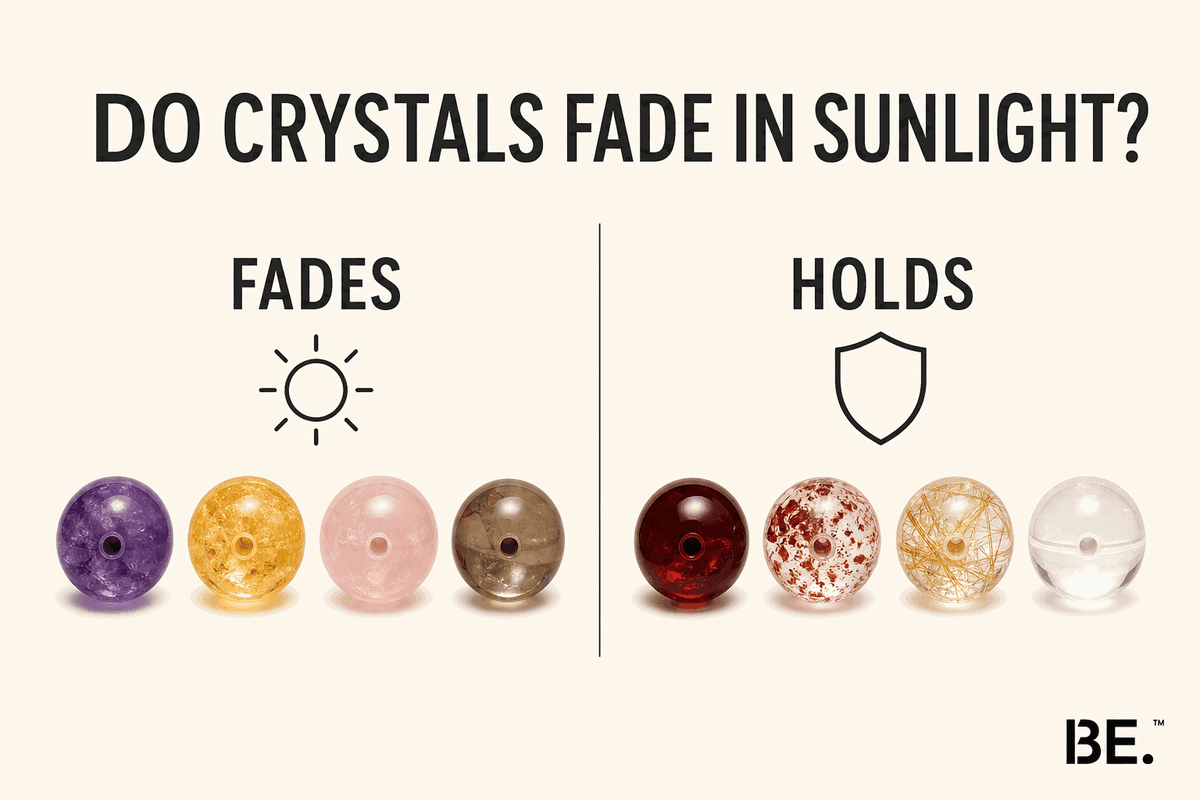
Welche Kristalle verblassen in der Sonne — und welche nicht?
Entscheidend sind die letzten beiden Spalten der Tabelle. Stammt die Farbe eines Steins aus einem Farbzentrum, sollte starke Sonne begrenzt werden. Stammt sie aus einem eingeschlossenen Mineral oder aus der Kristallstruktur, lässt er sich ohne Bedenken im Tageslicht tragen.
| Stein | Serie | Ursprung der Farbe | Verblasst in der Sonne? |
|---|---|---|---|
| Amethyst | Void | Eisen-Farbzentrum + natürliche Bestrahlung | Ja, langsam |
| Citrin | Prism | Eisen-Farbzentrum | Ja, besonders natürlicher Citrin |
| Rosenquarz | Flow | Farbtragende Nanofasern in untersuchtem massigem Rosenquarz; anderer rosa Quarz unterscheidet sich | Kein allgemeiner Zeitplan; langes intensives Licht bei unbekannter Vorgeschichte begrenzen |
| Rauchquarz | Anchor | Strahlungsinduziertes Farbzentrum in aluminiumhaltigem Quarz | Eine GIA-Studie: beim geprüften Material kein deutliches Verblassen; Mindat: Aufhellung bei langer UV-Einwirkung. Kein allgemeiner Zeitplan |
| Blauer Rauchquarz | Void | Beobachtetes Blau über rauchiger Basis; Mechanismus ohne Analyse nicht zugeordnet | Keine allgemeine Regel; langes intensives Licht begrenzen |
| Super Seven | Void | Gemischte Matrix mit Amethyst | Leicht — die Amethystzonen können heller werden |
| Granat | Anchor | Eisen in einem stabilen Kristallgerüst | Nein |
| Hämatoid-Quarz | Prism | Eisenoxid-Einschlüsse im Quarz | Nein |
| Rutilquarz / grüner Rutilquarz | Prism | Nadelförmige Einschlüsse aus Rutil oder Aktinolith | Nein |
| Grüner Phantomquarz | Prism | Chlorit-Einschlüsse | Nein |
| Phantomquarz | Flow | Eingeschlossene Wachstumsgrenzen | Nein |
| Bergkristall | Flow | Keine Farbe, die verloren gehen könnte | Nein |
| Aquamarin | Flow | Eisen im Beryll | Weitgehend stabil; starke, anhaltende Hitze vermeiden |
| Mondstein | Flow | Adulareszenz — ein optischer Effekt | Nein; wegen der geringeren Härte vorsichtig behandeln, nicht wegen des Lichts |
| Prehnit | Flow | Eisen im Silikat | Meist stabil; kann etwas heller werden |
| Kyanit | Void | Spurenelemente in einer stabilen Struktur | Nein |
| Goldglanz-Obsidian | Anchor | Optischer Glanz durch winzige Einschlüsse im vulkanischen Glas | Nein |
Diese Tabelle vertieft die Sonnenspalte der vollständigen Pflegetabelle, die für jeden Stein Licht, Wasser und Pflege nebeneinanderstellt.
Warum verblassen manche Kristalle?
Ein Farbzentrum ist ein elektronischer Defekt im Kristallgitter. Seine Chemie ist materialspezifisch: Amethyst und Rauchquarz lassen sich nicht auf einen universellen Eisen-Schalter reduzieren, und massiger Rosenquarz besitzt ein anderes untersuchtes Farbsystem. Vor einer Aussage zur Lichtreaktion stehen Materialbestimmung und Behandlungsgeschichte.
Licht kann bestimmte Farbzentren verändern; die Reaktion hängt jedoch von Defektchemie, Behandlung und Exposition ab. Für Rauchquarz berichtete eine GIA-Licht-/Wärmestudie beim geprüften Material kein deutliches Verblassen, während Mindat Aufhellung nach lang anhaltender UV-Einwirkung nennt. Dieser Widerspruch verlangt materialspezifische Grenzen statt einer universellen sicheren Stundenzahl oder eines festen Monatsplans. Die Rauchquarz-Grenze erklärt Rauchquarz und natürliche Bestrahlung.
Farbstabile Steine speichern ihre Farbe anders. Hämatoid-Quarz ist rot, weil Eisenoxid-Minerale im Silica eingeschlossen sind; Rutilquarz zeigt goldene Rutilnadeln; grüner Phantomquarz enthält Chlorit in versiegelten Schichten. Das sind physische Einschlüsse, keine elektrischen Zustände, und Licht verändert sie nicht. Im Granat sitzt Eisen fest in einem dichten, stabilen Gerüst. Deshalb behält Granat sein tiefes Rot über Jahrzehnte des Tragens.
Ist ein verblasster Kristall ruiniert?
Nein. Ein Stein, dessen Farbe sanfter geworden ist, verhält sich wie andere Materialien, die gerade wegen ihrer Gebrauchsspuren geschätzt werden.
Raw Denim beginnt dunkel und steif und hellt über einige Jahre genau dort auf, wo der Körper Falten bildet — an den Knien, am Gesäß und an der Stelle einer Geldbörse. Das gilt nicht als Schaden. Es ist ein Grund, Raw Denim überhaupt zu tragen: Der Stoff zeichnet die Person auf, die ihn getragen hat. Leder verhält sich ähnlich. Gute Stiefel oder ein schlichtes Lederarmband für eine Uhr werden durch Gebrauch dunkler und geschmeidiger. Diese Oberfläche — die Patina — wird geschätzt, nicht repariert. Die Spur des Gebrauchs ist der Sinn.
Ein über Jahre im Tageslicht getragenes Mineral mit Farbzentren folgt demselben Weg. Das sanftere Violett oder hellere Braun zeichnet das Licht auf, das der Stein an einem bestimmten Handgelenk erlebt hat. Wer das verhindern möchte, bewahrt das Armband außerhalb langer direkter Sonne auf; dann bleibt es wie am ersten Tag. Verändert sich der Ton dennoch, ist das kein Verlust. Es ist etwas, das ein Massenprodukt nicht vortäuschen kann: eine Geschichte, die nur der Person gehört, die den Stein getragen hat. Die Farbe des Steins ist Geologie; welche Bedeutung die Veränderung erhält, bleibt offen.
So lässt sich das Verblassen verlangsamen
Mögliches Verblassen zu begrenzen ist einfach und kostet nichts. Es geht um kontrollierbare Exposition, nicht um eine universelle sichere Stundenzahl: Normales Tragen ist kürzer und kühler als ein Sommer auf einer sich aufheizenden Fensterbank.
- Nicht im Licht aufbewahren. Die Wirkung summiert sich. Deshalb ist der Aufbewahrungsort wichtiger als die einzelne Stunde am Handgelenk. In einer Schublade, einem Beutel oder einer Schachtel steht die Uhr still. Mehr dazu: Kristallarmbänder richtig aufbewahren.
- Sonnige Ablagen vermeiden. Ein Mineral mit Farbzentren wochenlang auf einer Fensterbank liegen zu lassen, ist der häufigste unbeabsichtigte Grund für verblassten Amethyst.
- Im Schatten trocknen. War ein Armband im Wasser, sollte es auf einem Tuch außerhalb direkter Sonne trocknen. Ein nasser Stein in starkem Licht belastet die Farbe stärker als Wasser oder Licht allein.
- Keine dauerhafte Verblassen/Farbstabil-Binärregel. Einschluss- und gittergefärbte Materialien verhalten sich häufig unterschiedlich; Beschichtungen, Farbstoffe, Behandlungen und Probengeschichte können die Antwort verändern. Eine Gruppenzuordnung garantiert keine unbegrenzte Stabilität.
Wie BE. dies dokumentiert
Jeder BE. Strang wird mit einer Stone Origin Record geliefert, die das Material und jede Behandlung nennt. So ist von Anfang an erkennbar, ob die Farbe in einem Farbzentrum oder einem Einschluss sitzt — und ob Sonnenlicht begrenzt werden sollte. Die Crystal 4T Bewertung umfasst Transparency, Tone, Texture und Treasure. Lichtstabilität ist eine Zusatzangabe zu Tone und keine eigene Qualitätsstufe, denn sowohl ein potenziell verblassender als auch ein farbstabiler Stein kann ausgezeichnetes Material sein.
Häufig gestellte Fragen
Q1.Verblasst Amethyst im Sonnenlicht?
Ja, langsam. Das Violett des Amethysts stammt aus einem Eisen-Farbzentrum, das ultraviolettes Licht über Monate direkter Sonne zurücksetzen kann. Dadurch verschiebt sich die Farbe in Richtung Grau oder wird blasser. Außerhalb langer direkter Sonne bleibt sie erhalten.
Q2.Welche Kristalle verblassen in der Sonne?
Amethyst und Rauchquarz besitzen Farbzentren, aber keine universell gleiche Defektchemie oder Lichtreaktion. Massiger Rosenquarz hat ein anderes untersuchtes nanofaserbezogenes Farbsystem; transparenter rosa Quarz und behandeltes Material benötigen eigene Nachweise. Entscheidend sind das genaue Material und die Offenlegung.
Q3.Verliert Rosenquarz seine Farbe?
Unter lang anhaltendem UV-Licht kann das Rosa heller werden, ähnlich wie beim Amethyst. Wasser und normales Tragen verändern es nicht; lange Zeit auf einer sonnigen Fensterbank schon. Außerhalb direkter Sonne bleibt das Rosa erhalten.
Q4.Kann ein verblasster Kristall seine Farbe zurückerhalten?
Nicht zu Hause. Die Veränderung ist eine Verschiebung in den Farbzentren des Steins. Eine Umkehr erfordert Bedingungen, die sich am Handgelenk nicht erzeugen lassen. Praktisch hilft Vorbeugung: Steine aus der verblassenden Gruppe nicht lange direkter Sonne aussetzen.
Q5.Ist es problematisch, einen Kristall zu tragen, der verblasst?
Nein. Eine leichte Aufhellung über Jahre ist eine Gebrauchsspur — wie verblichenes Raw Denim oder die Patina auf Leder. Schatten und richtige Aufbewahrung können sie verhindern. Verändert sich ein Stein dennoch, ist er nicht beschädigt; er hat lediglich das Licht aufgezeichnet, in dem er getragen wurde.
Q6.Wie verhindert man, dass ein Kristallarmband verblasst?
Bei Nichtgebrauch außerhalb des Lichts aufbewahren, nicht auf sonnigen Fensterbänken liegen lassen und nach Wasserkontakt im Schatten trocknen. Normales Tageslicht ist unproblematisch; entscheidend ist anhaltende direkte Einwirkung.
Quellen
- Mindat — Mineraldaten zu Quarz
- GIA Gem Encyclopedia — Quarz
- Wikipedia — Farbzentrum (F-Zentrum)
- Nassau, K. (2001). The Physics and Chemistry of Colour, 2. Auflage. Wiley.
- Rossman, G. R. — Mineral Spectroscopy (Caltech), Referenzen zu Farbzentren.
Field Notes.
Ein Stein nach dem anderen: seine Geologie und woran sich Qualität erkennen lässt. Die Checkliste für den Steinkauf kommt mit der ersten E-Mail.
Mit der Anmeldung erhalten Sie E-Mails von BE. Sie können sich jederzeit abmelden.
Gesendet. Schauen Sie in Ihr E-Mail-Postfach.