- von BE.
Is a Blue Needle Quartz Bracelet Worth It? How to Choose
- von BE.
If you have looked at a blue needle quartz bracelet and hesitated at the price, the honest question is not "why is it more expensive" — it is "is the blue real, and will it last." Both answers are yes. This guide explains what you are actually paying for. For the full mineralogy — what dumortierite is and why the blue forms — see our blue needle quartz guide.
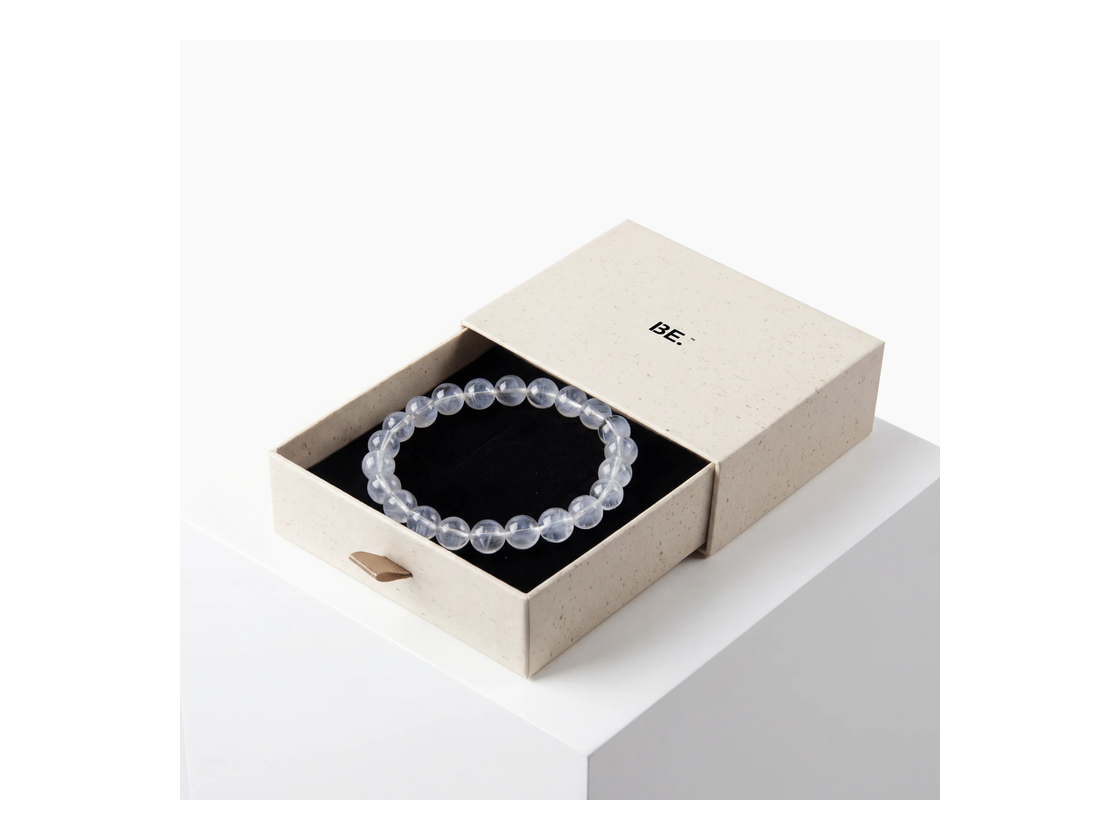
Common quartz colours — purple, pink, gold — are relatively abundant. Natural blue is not. It needs a second mineral, dumortierite, to grow inside the quartz at the same time, a rare geological coincidence. Scarcity, plus the fact that the best material balances visible blue with a clear host, is what sets the price. You are not paying for a brand; you are paying for a colour that is genuinely hard to source.
Three checks, no equipment needed.
For the full five-point check, see the blue needle quartz guide.
Blue needle quartz suits someone who prefers a quiet, uncommon blue over a loud one, wants a stone with a real story — the colour is a fluke of geology — and values that no two strands are identical. It is also durable: a Mohs 7 host with dumortierite inclusions harder still, so it wears daily without babying.
BE. grades blue needle quartz on the Crystal 4T standard — Transparency, Tone, Texture, Treasure — with the Stone Origin Card naming the real inclusion mineral (dumortierite) and the Lot ID, so the blue is disclosed as natural, not implied.
Yes, if you want a naturally blue stone rather than a dyed one. Blue is the rarest colour in quartz; blue needle gets it from real dumortierite inclusions, and it is Mohs 7, hard enough for daily wear.
Natural blue sits through the whole bead; dyed blue pools in surface cracks. If the colour is only in the cracks, it is dyed.
Natural (not dyed), blue visible without effort in daylight, and a host clear enough to see both needles and clear quartz in the same bead.
Yes — Mohs 7 host, dumortierite inclusions harder still. Avoid hard knocks; clean with warm soapy water.
Natural blue is scarce — it needs dumortierite to grow inside the quartz at once, a rare coincidence. Scarcity sets the price, not branding.
Teilen:
Amethyst vs. Granat: Zwei dunkle Steine, unterschiedliche Geschichten
Steinfinder: Kristall-Armband nach Farbe & Härte wählen